The short version
- Bitcoin is a digital currency run by a network of computers, with no company or government in charge of it.
- Its supply is capped at 21 million coins; the rate of new issuance halves roughly every four years, most recently in April 2024.
- It pays no income and its price has repeatedly fallen by more than half, so position size matters more than timing.
What is Bitcoin? It is a digital currency that lets two people transfer value over the internet without a bank in the middle, recorded on a public ledger that anyone can check and no single party controls. It was described in a 2008 paper published under the name Satoshi Nakamoto, whose real identity is still unknown, and the network started running in January 2009.
How the network runs
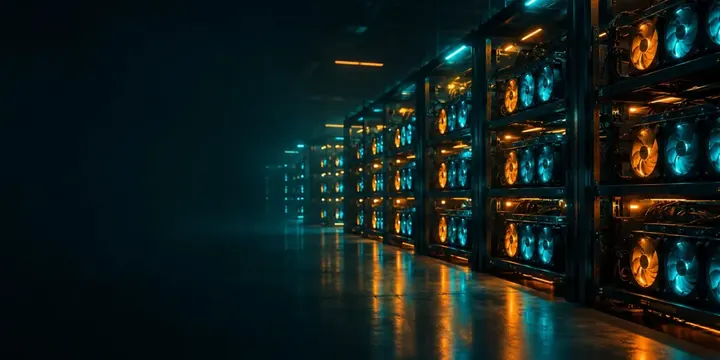
Bitcoin transactions are collected into blocks, and a new block is added roughly every ten minutes. The computers that add blocks, called miners, compete to solve a puzzle that takes a great deal of computing power. The winner adds the next block, collects the transaction fees in it and receives a set amount of newly created bitcoin, the block reward. This process, proof of work, is what secures the ledger: rewriting history would require outspending the rest of the network on computing power and electricity.
Anyone can run a full node, a copy of the software that checks every rule independently. That is why no company can simply change the supply or reverse a payment: the nodes would reject the change.

The fixed supply and the halvings
Bitcoin's rules cap the total supply at 21 million coins. New coins enter only through block rewards, and the reward is cut in half every 210,000 blocks, roughly every four years. These events are called halvings.
| Period | Reward per block |
|---|---|
| 2009 to 2012 | 50 BTC |
| 2012 to 2016 | 25 BTC |
| 2016 to 2020 | 12.5 BTC |
| 2020 to April 2024 | 6.25 BTC |
| April 2024 onward | 3.125 BTC |
| Next halving, expected around 2028 | 1.5625 BTC |
With about 144 blocks a day, the current reward means roughly 144 × 3.125 = 450 new bitcoin a day. Each halving reduces new supply, but whether that affects the price depends on demand, which no rule controls. Past price patterns around halvings are not a reliable guide to future ones.
Units, wallets and ownership
A bitcoin can be split into 100 million smaller units called satoshis, or sats. You do not need to buy a whole coin. As an illustration, if one bitcoin cost $80,000, then $50 would buy 50 ÷ 80,000 = 0.000625 BTC, which is 62,500 satoshis.
There are three common ways to hold exposure:
- On a platform: you buy through an exchange or broker that holds the coins for you. Simple, but you depend on that firm.
- In your own wallet: you control the private keys, often backed up as a seed phrase. No firm can freeze your coins, but no one can recover them if you lose the keys.
- Through a fund: in the US, exchange-traded products holding bitcoin began trading in January 2024, letting investors hold exposure in an ordinary brokerage account. Fund fees and the fund's own custody arrangements then apply.
Our guide to how crypto works explains keys and wallets in more detail.
What is Bitcoin used for today?
Uses vary widely by country and by person. Some treat bitcoin as a long-term store of value, arguing that its fixed supply protects it from the currency debasement they fear in government money. Some use it to send value across borders, particularly where banking is restricted or expensive. A small number of merchants accept it as payment, sometimes through faster networks built on top of Bitcoin such as the Lightning Network. And a great deal of activity is plain speculation on the price. Each use carries a different set of risks, and none of them has made the price stable.
Why the price moves so much
Bitcoin has no earnings, dividends or interest to anchor a valuation. Its price reflects what buyers are willing to pay, which depends on adoption, regulation, interest rates, the flow of money into funds and plain sentiment. Supply cannot respond to demand, because issuance is fixed by the protocol, so shifts in demand move the price rather than the quantity. The result is a history of large rallies and falls; declines of more than half from a peak have happened several times.
Because the market never closes, big moves can happen at weekends or overnight. Leverage on crypto platforms can make these moves self-reinforcing, as forced selling triggers further selling.
Common misunderstandings
- "Bitcoin is anonymous." It is pseudonymous. Every transaction is public, and addresses can often be linked to people, especially through platforms that verify identity.
- "The blockchain makes it safe." The ledger is hard to tamper with, but most losses come from scams, stolen keys and failed platforms, not from the protocol.
- "Scarcity guarantees value." A fixed supply limits new coins; it does not guarantee that anyone will want them at a given price.
Energy use and the debate around it
Proof of work deliberately consumes computing power, and therefore electricity, to secure the network. Critics argue that this energy use is hard to justify; supporters reply that miners increasingly use surplus or stranded power and that the cost is what makes the ledger secure. Estimates of the network's consumption come from outside researchers and vary with their methods. For investors, the debate matters because it affects regulation and the willingness of some institutions to hold bitcoin.
Storing bitcoin safely
- If you use a platform, turn on two-factor authentication with an app or security key rather than text messages, and use a unique password.
- If you hold your own keys, write the seed phrase on paper or metal and keep it offline, never in a photo, email or cloud note.
- Consider how someone you trust could access your holdings if something happened to you, without exposing the keys today.
- Be suspicious of any message, even one that appears to come from a wallet maker, asking you to "verify" or "restore" your wallet.
Bitcoin and a long-term portfolio
Investors who hold bitcoin generally treat it as a small, high-risk position rather than a core holding, and size it so a severe fall would not derail their plans. Before buying, it is worth writing down how much of your portfolio you would hold, how you would store it, and what you would do after a 60% fall. If those answers are unclear, the position is probably too large. Our crypto profit calculator shows how fees change the result of a trade.
Reader questions
Who controls Bitcoin?
No single person or company. The rules are enforced by the software that thousands of independent nodes run. Changes require broad agreement, which is why core features such as the 21 million cap have not changed.
When is the next Bitcoin halving?
Halvings happen every 210,000 blocks. After the April 2024 halving, the next one is expected around 2028, but the exact date depends on how quickly blocks are produced.
Do I need to buy a whole bitcoin?
No. Bitcoin divides into 100 million satoshis, and platforms usually let you buy small fractions. Fees can take a larger share of very small purchases, so check them first.
Sources
- Satoshi Nakamoto, Bitcoin: A Peer-to-Peer Electronic Cash System (2008)
- Bitcoin Core protocol documentation, block subsidy schedule
- US Securities and Exchange Commission, approval of spot bitcoin exchange-traded products (January 2024)
- UK Financial Conduct Authority, ban on crypto-derivatives for retail consumers